


The Beautiful Lamp
🌱 From Wonder Observation 0045
A winter sunset, an old streetlamp, and a quiet question about why we make ordinary things beautiful.
A Wonder Essay from The Wonder Atlas
Learning to see, one wonder at a time.

I had spent the afternoon walking in the Ochil Hills above Dollar.
It was 5 January, and by the time I began coming down from King’s Seat, the winter sun was setting.
The sky seemed to change with every few steps.
Orange along the horizon.
Gold.
Pink spreading slowly into blue.
I kept looking.

Far below lay Dollar, a small Scottish village gathered beneath the hills. Castle Campbell sits tucked into the glen above it. Old stone buildings line parts of the village, and the burn runs down through its centre before continuing towards the River Devon.
I had known Dollar for years.
But that evening I was seeing it from above as daylight disappeared.
By the time I reached the car and began driving home, the colours in the sky were fading and darkness was settling over the village.

Christmas had passed, but the tree beside the old church was still there, covered in white lights.
Then something else caught my eye.
A streetlamp.
I had spent the last part of the afternoon watching colour spread across an enormous sky.
Now, somehow, colour had caught me again.
This time it was contained within something small.
Red and gold light shone through painted glass against the darkness.
It caught my attention strongly enough that I stopped.
I got out of the car and walked towards it.
From a distance, it had been the colour.
Closer, I began noticing the shape.
The metalwork.
The painted panels.
The different images in the glass.
I wasn’t thinking about design.
Or craftsmanship.
Or architecture.
There was no great revelation.
I simply thought it was beautiful.
So I stayed for a while.
Only afterwards did the question arrive.
Why is this lamp like this?
Most streetlights are remarkably easy not to see.
They stand beside roads and pavements doing exactly what we need them to do. They give light. We benefit from them every evening without giving much thought to the objects themselves.
I cannot remember the last time an ordinary streetlight made me stop the car simply to look at it.
Yet this one had.
Why?
Why the colour?
Why painted glass?
Why this shape and metalwork?
Why make an ordinary thing beautiful when it only needs to work?
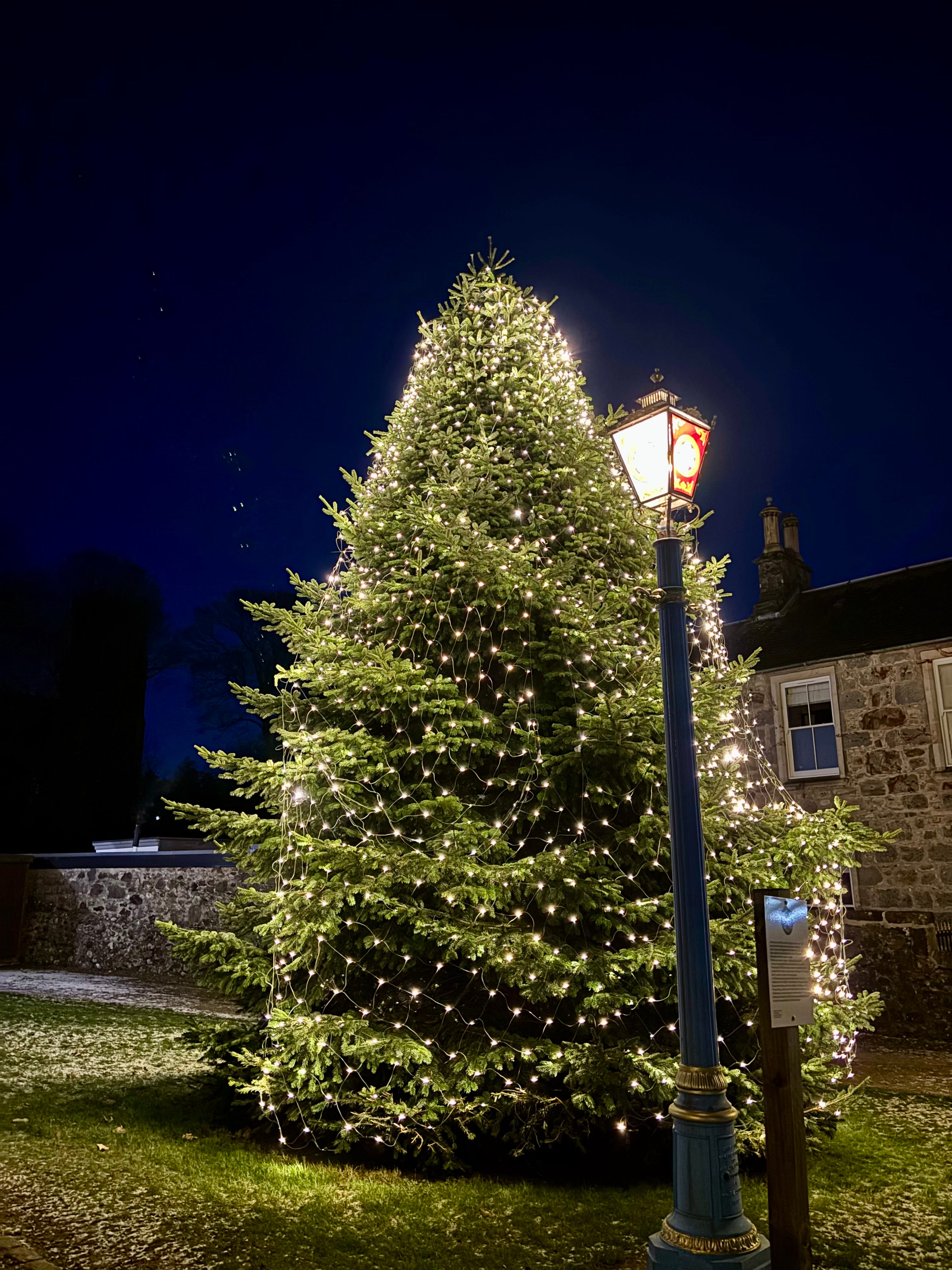
At first, I thought I understood more of the answer than I actually did.
I imagined someone deciding to spend extra time and money creating something beautiful for other people to enjoy.
I imagined a craftsperson somewhere.
Someone caring enough to make more than was necessary.
It was a lovely story.
The problem was that I didn’t know if it was true.
When I later went looking for the history of the lamp, I discovered that it had a very practical reason for existing.
It is Dollar’s Provost’s Lamp.
Provost lamps were used to identify the home of the town’s chief magistrate so that the Provost could be found when needed.
The lamp had a job.
That discovery corrected me.
I could no longer say that somebody had commissioned it simply because they wanted to put beauty into the village.
I don’t know that.
I don’t even know the names of the people who designed or made its different parts.
But the correction did not make the lamp less interesting.
It made the question better.
Because however practical its original purpose was, function did not exhaust what had been made.
There was still painted glass.
Colour.
Metalwork.
Form.
Symbol.
Somebody — probably several somebodies — had made choices about what this useful thing would be like to encounter.
And I began wondering whether that question matters more often than we realise.
We make things to do things.
A chair needs to hold us.
A bridge needs to carry us.
A lamp needs to give light.
Function matters.
But human beings never encounter function on its own.
We encounter shape.
Colour.
Material.
Comfort.
Light.
We experience the things around us while they are doing their jobs.
Perhaps Does it work? is sometimes only the first question.
There may be another one.
What is it like for someone to encounter?
This is not an argument for older things over newer ones.
Age does not make something beautiful.
Ornament does not either.
Something simple can be beautiful.
Something mass-produced can carry extraordinary care.
The question is not really about style.
It is about attention.
How much thought has been given not only to what something must do, but to the experience it creates while doing it?
That question brought me back to the lamp.
Its original civic purpose has largely disappeared.
I had no need to find the Provost’s house that January evening.
I did not even remember the history after I had read it.
What stayed with me was something else.
The colour.
The glow.
The darkness.
The enjoyment.
People involved in making that lamp nearly a century ago could not have known that I would drive through Dollar on 5 January 2026.
They could not know that I would have spent the afternoon watching the winter sky turn orange and pink above the Ochils.
They could not know that I would notice their lamp.
And yet I did.
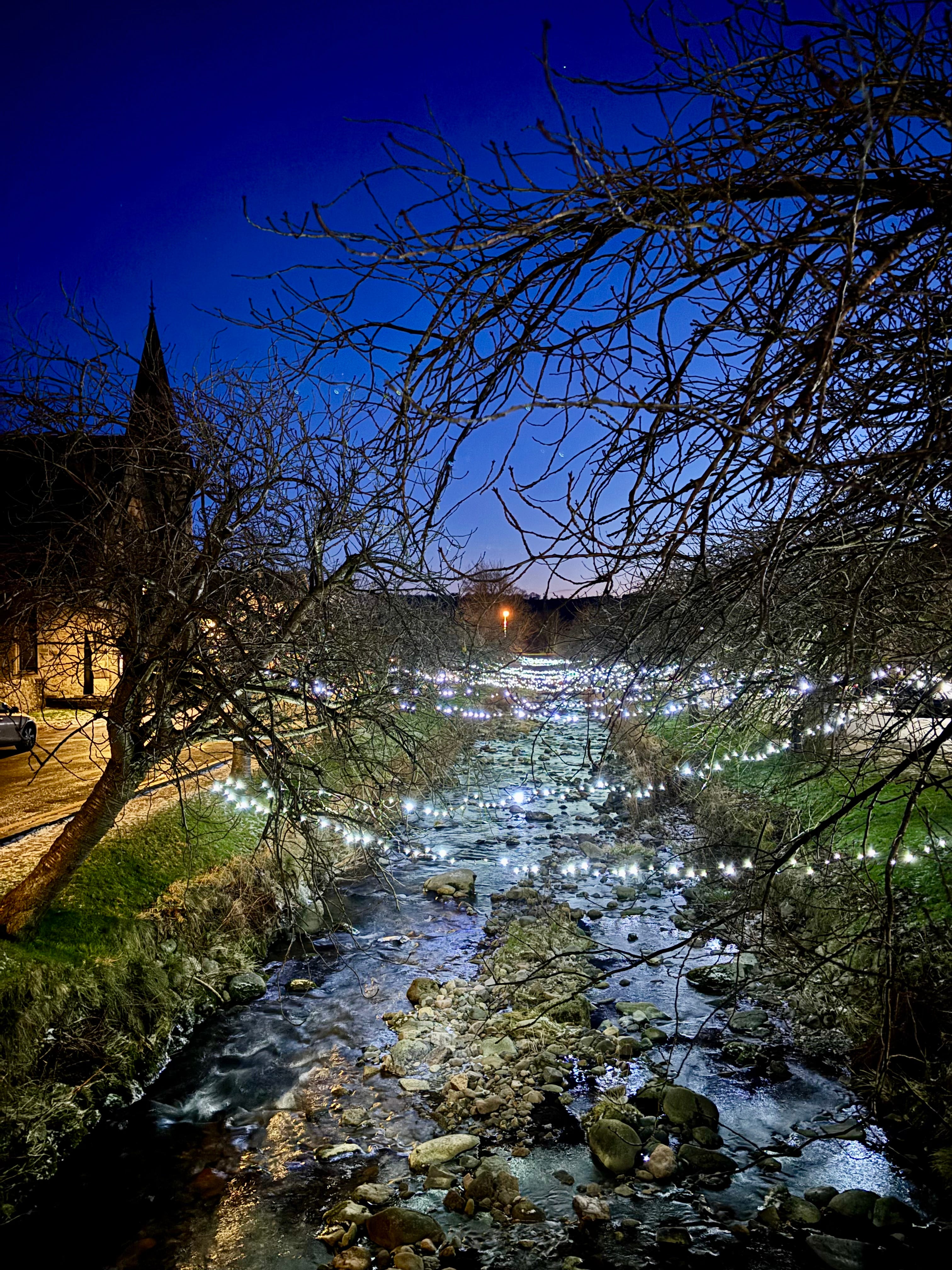
Choices made in another generation became part of an ordinary evening in mine.
That is where I began to think about the word gift.
Not because I can claim that the lamp was made as a gift for me.
It wasn’t.
Not because I know what its makers intended.
I don’t.
But because I received something from it.
Enjoyment.
Attention.
A reason to stop.
Sometimes care travels further than the people who first gave it form.
Someone plants a tree whose shade they may never sit beneath.
Someone places a bench where strangers will one day rest.
Someone shapes or tends something that will become part of another person’s ordinary day.
Most of the people who benefit will never know their names.
The thought stayed with me.
Much later, it led me back to a small sentence near the beginning of Genesis.
The trees of the garden are described as both pleasing to the sight and good for food.
I had read those words many times.
I had never really noticed the pairing.
They nourish.
And they delight.
One does not cancel the other.
That felt especially striking after the afternoon I had spent in the hills.
The sunset did not need to justify why I enjoyed its colour.
I simply received it.
Then, a little later, I encountered colour again — not spread across the sky this time, but shining through glass shaped by human hands.
I do not need to make the two things equivalent.
They aren’t.
One belonged to the winter sky.
The other to an old lamp beside a Scottish road.
But both reminded me that usefulness does not exhaust goodness.
There is room in life for delight.
There is room for things that work well and are also good to encounter.
And there is something quietly moving about realising that care can travel.
Since then, I have found myself noticing ordinary things made by people I will never know.
Not because every object hides some profound story.
Most probably don’t.
But occasionally I notice a detail I might once have passed without seeing.
A shape.
A material.
A small piece of colour.
Something comfortable.
Something beautifully simple.
Some trace that somebody thought about more than the bare minimum required to make the thing work.
I still do not know why the people behind the Dollar lamp chose every detail they did.
I may never know.
Perhaps that uncertainty is good for me.
It means I cannot turn them into heroes in a story I have invented.
I can only receive what is actually there.
A lamp.
Colour shining through glass.
Care carried in material.
And an ordinary winter evening made a little more enjoyable because of it.
When I think back to that day now, I first see the sky.
Orange and pink stretching across the horizon as I came down from the Ochils.
Then darkness.
A village beneath the hills.
An old church.
A Christmas tree still shining in January.
And beside it, a much smaller pool of colour.
I stopped because I thought it was beautiful.
Everything else came later.
Maybe that is still the most important part.
To notice.
To enjoy.
To move closer.
And to wonder what else we have been passing every day without really seeing.
◆
Continue the Wonder
Every Wonder Essay begins with a simple observation.
Some readers are content simply to pause and wonder.
Others want to keep exploring.
If you’d like to follow this observation further, I’ve created a Research Companion exploring beauty and ordinary experience, design and craftsmanship, the history of Dollar’s Provost’s Lamp, care carried across generations, and the theological questions that grew from this Wonder Seed.
Continue exploring → [Research Companion]
A note on process: This essay grew from a real lived observation and experience, recorded through the Wonder Atlas process. It was then developed in collaboration with ChatGPT through an iterative process of questions, responses, reflection, drafting and editing. I contributed the originating experience, photographs and reflections, answered questions throughout the process, shaped and reviewed the developing essay, and approved the final published text. I take responsibility for the final work.